
From 9 to 22 November 2026, PUSAN followed COP31, the UN climate conference in Antalya, Türkiye, every day. Our Executive Director, Abdirabi Mohamed, wrote Sahan Tracker, a daily edition of his newsletter The Resilience Gap, so that young people, civil society and partners in Somalia and beyond could follow the talks in plain words.
Each edition gave a simple score: what moved forward, what got stuck and what to watch next. Every hard word got an explanation and every number got a source, mostly the Earth Negotiations Bulletin, the UN and journalists who were in the rooms.
What happened at COP31
The first fight was about money. On day one, developing countries got climate finance onto the agenda, but adaptation finance did not get a topic of its own. In the first week, the Global Environment Facility announced a funding round with 27% less money, and Solomon Islands became the first small island developing state to pledge to the Green Climate Fund replenishment.
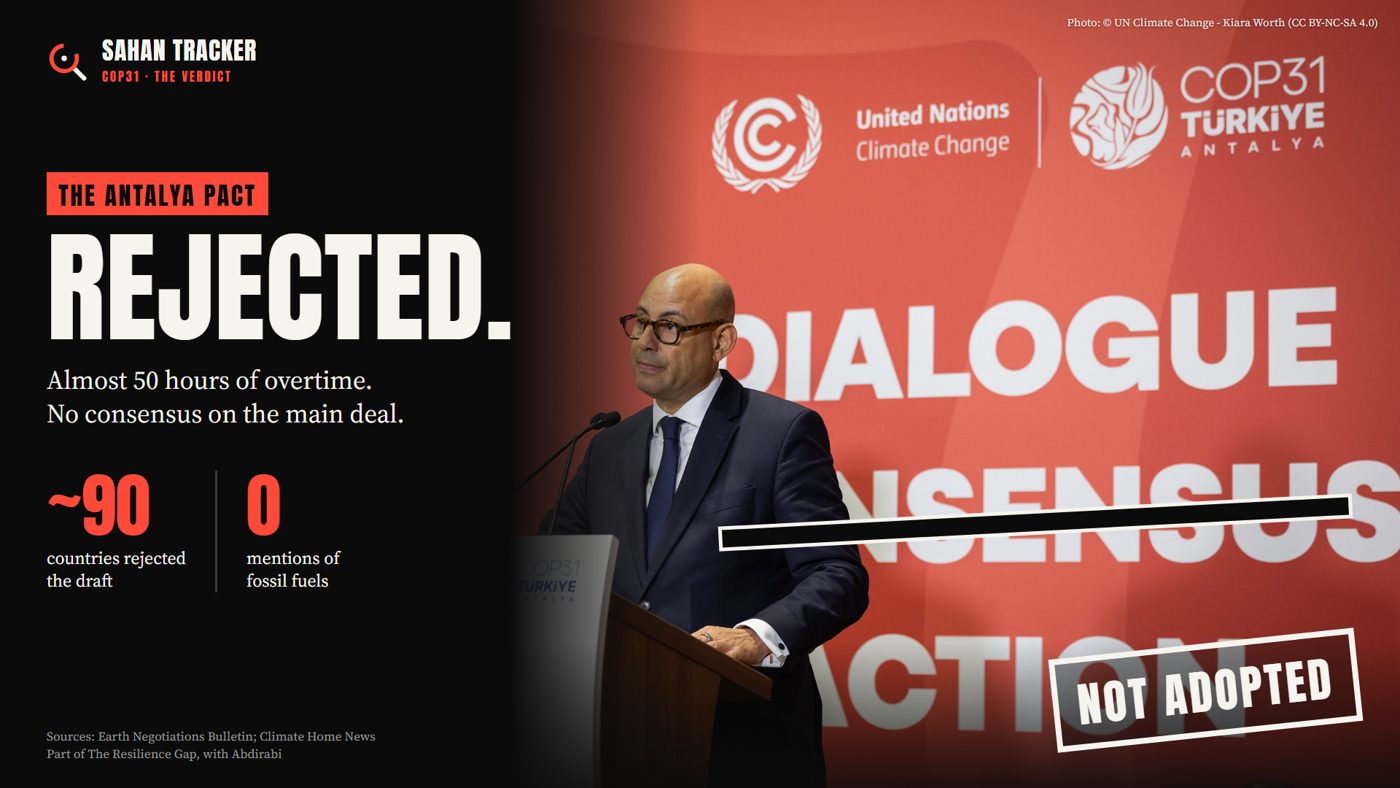
In the second week, a first draft of the cover decision proposed to triple adaptation finance to at least USD 120 billion a year by 2035. A shorter second draft dropped that figure and every mention of fossil fuels. COP31 ran almost 50 hours into overtime and ended at 7:33 pm on Sunday 22 November. The two cover decisions, together called the Antalya Pact, were not adopted because there was no consensus.
Read every edition
- COP31, Day 1: The talks open, and the first fight is about money
- COP31, Day 2: The talks got real. The money got smaller.
- COP31, Day 3: The leaders came. The money did not.
- COP31, Day 4: A small island gave. Few others did.
- COP31, Day 5: Everyone has a wish list. The money is shrinking.
- COP31, Week 1: Much was sent forward. Little was funded.
- COP31, Day 8: The ministers arrived. The red lines did not move.
- COP31, Day 9: One room agreed. The rest are waiting.
- COP31, Day 10: The text got shorter. So did the promises.
- COP31, overtime: The clock ran out. The deal did not come.
- COP31, outcome: No consensus. The Antalya Pact was rejected.
Why this matters for PUSAN
Following the money from promise to community is Pillar 5 of our Strategic Plan 2027–2031: research, policy and climate finance accountability. Sahan Tracker is an early piece of that work. It shows what was promised for adaptation and what was left out, which is what communities in places like Jariiban need to know.
Subscribe to The Resilience Gap on LinkedIn to get the next editions.